
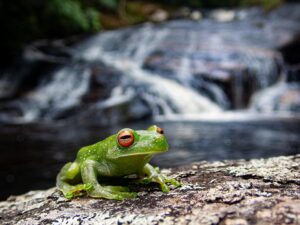
An Atlantic Forest treefrog, Aplastodiscus leucopygius, at the edge of a rocky forest stream in Brazil’s Atlantic Forest, transitioning between aquatic and terrestrial environments. Credit: Shannon Buttimer
Biology Professor Doug Woodhams, members of his lab, and other collaborators have published a new article entitled, “Connecting Habitats, Boosting Disease Resistance: Spatial Connectivity Enhances Amphibian Microbiome Defenses Against Fungal Pathogen.” The article describes how landscape disruption can lead to increased disease risk in wildlife. The research links landscape connectivity, beneficial microbes, and disease resistance, finding that connectivity among habitats maintains biodiversity across scales from microbial to host community. Published in the journal Proceedings of the National Academy of Sciences
Press release Mongaby EurekAlert! Smithsonian Tropical Research Institute Bioengineer.org Mirage News ScienMag
Professor Woodhams is especially proud of first author Daniel Medina, who began working as a research assistant with Dr. Woodhams in Panama as an undergraduate student. He then pursued graduate studies at Virginia Tech followed by a postdoc at Penn State where he conducted the published research, and is now a lecturer in tropical forest ecology and resource management at The School for Field Studies.